
In Avignon, Avant-garde A.I. Theater to Meet the Moment
by Haley Wakelam
« Je ne sais pas si je vais pouvoir rester jusqu’à la fin. »
Some 30 minutes into the performance, Aurélie, my dear friend and intrepid Avignon theatergoer, had discreetly and as respectfully as possible craned her neck to my ear to deliver a desperate message: SOS. Pénible was the word that had been on my mind for some time, too, even as I sat hunched forward in my seat, chin perched in hand, no doubt willing myself the air of an intellectual who knew how to appreciate the avant-garde work of English-language theater before her.
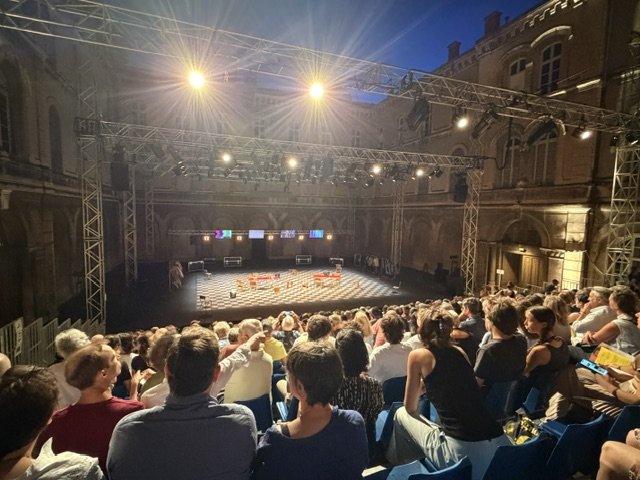
We had come to witness the UK-based Forced Entertainment’s production Everything Must Go, selected as one of the highly prestigious and internationally curated offerings of the official Avignon “In” Festival. As we settled into the Cour du Lycée Saint-Joseph - one of Avignon’s coveted outdoor venues - for the 10 PM show, the mistral gently billowed the soft curls of the woman sitting before us, a welcome rejoinder to the day’s intense heat and a reminder that, at least for this brief moment, France had broken the slog of back-to-back canicules.
Everything Must Go made short shrift of that feeling of momentary respite: it is set in a climate-ravaged future in which the economy has collapsed, and humans have been forced underground to kill time in a fantastical bar à la Cheers, their voices replaced by A.I.-generated ones. Essentially plotless, the 1 hour forty-minute performance consists of the six-actor troupe caught in a drawn-out loop of insipid slapstick set to a continuous laugh track, as though the humans of the future will be forced to mine sitcom tropes from a distant and meaningless past – our present.
The checker-board flooring on which the actors stumble and flounce en dit long sur the despair of the anonymous caricatures who seem to no longer know how to come together, instead repeatedly breaking the fourth wall as they look wide-grinned to the audience to make meaning of their actions. They struggle to cohere with the A.I.-generated voices that consistently bug, sometimes repeating single lines a dozen, twenty times over and most jarringly – and most impressive from a sheer technical perspective – creating a convincing lag between the A.I.-generated voices and the actors’ movements.

The play hemorrhaged audience members, with several dozen not-so-discretely heading for the exit. As for my friend Aurélie, it was the laugh track that threatened to do her in. Watching the deluge felt akin to what it must have been like to witness the debut of Stravinsky’s 1913 début of The Rite of Spring. Pénible. Malaisant. Avant-garde. Avertisseur.
Watching the actors insistently recycle lines and repeat movements reminded me of the rituals for which a child might grasp at to fend off uncertainty. I was additionally reminded of the digital theorist Tung-Hui Hu’s has called digital lethargy, a form of timepass or of subsisting within a digitalized world that would force our emotional liveliness - our own unique laugh track – for clicks, for swipes right on dating apps, for an ATS-friendly résumé.
To the patient and compassionate observer, the writing of Everything Must Go is clever, frightfully absurd, and yes, compassionate towards the A.I.-degenerate humans of the future. True to what critics have pointed out as A.I.’s overreliance on sensorial and spatial metaphors to compensate for its inability to experience the world, “We’re in deeeeep water here” becomes a comedic refrain by which the actors try to make sense of their own degraded sensorial existence.
Deprived of human speech and cadence, the characters (caricatures) are aware of their sensorial and speech deprivation. “The words I have…are not good words” likewise becomes a common refrain traded among the troupe’s members. Algorithmic buzzwords of the powers that be - finance, fintech, consulting firms, and military contractors - are interwoven at random with AI-generated dialogue. Left hook, right hook, Lockheed Martin. Are we to understand these names as ominous referents to the forces that eventually drove humans underground?
“…to play the line between what is comical and what is terrible, between what is comical and what is tragic or painful.”
In an official interview given in anticipation of the work’s Avignon début, writer Tim Etchells describes the show’s underlying wager: sacrificing plot and even enjoyability to parody A.I.’s ability to predict and render human dialogue as inoperable, unpredictable, “de mettre en défaut le programme.” Etchells continues that one of the most remarkable things that theater allows us to do is to “play the line between what is comical and what is terrible, between what is comical and what is tragic or painful.”
_______
Make no mistake: to attend the Festival d’Avignon is to delight the senses. Contained within the fortified white walls of the Ville des Papes, cobbled medieval alleyways beckon, as does the prospect of a lunch of a tarte au chèvre, washed down with cider, in picturesque plazas beneath Provence’s iconic plane trees. In the streets, magicians, acrobats, and actors put it all on the line to vie for your patronage of their passion project. They spontaneously break out in song, backflip off public fountains, and peddle promises to take down capitalism through that evening’s interactive sing-along, as at least one novel production promised to do.

But in dark theaters and outdoor amphitheaters, for three weeks in July, from 10 AM to 10 PM, some 300 shows – dozens at once – continue to offer a rare venue from which to play the fine line, with utmost earnestness, between the comedic and the terrible. That theater can continue to offer us that space is worth cherishing.
So much for the evening’s respite from the summer’s unwavering heat. France is burning in an unprecedented outbreak of wildfires [HW2] and faced with an infrastructural and public health crisis to equip a largely air-condition-less country against fatal heat. Meanwhile, data centers built to fuel A.I. are warming the planet faster, and yet A.I. is viewed more favorably in poorer countries than it is in wealthy countries like the US and France. That contradiction is worth thinking about, too: Everything Must Go’s “A.I. pessimist” outlook is not the final say on what our A.I.-driven future will look like nor the boons it may yet afford to the global economic underclass. But Everything Must Go is an effective if eerie bet that the two – the A.I. cliff and the climate crisis – are at least worth thinking about together.
As for Aurélie, she was glad she stayed until the end. She hopes the theater of the future will stick to more legible parameters.
