
An interview with Hanna Lasserre, conducted by Haley Wakelam
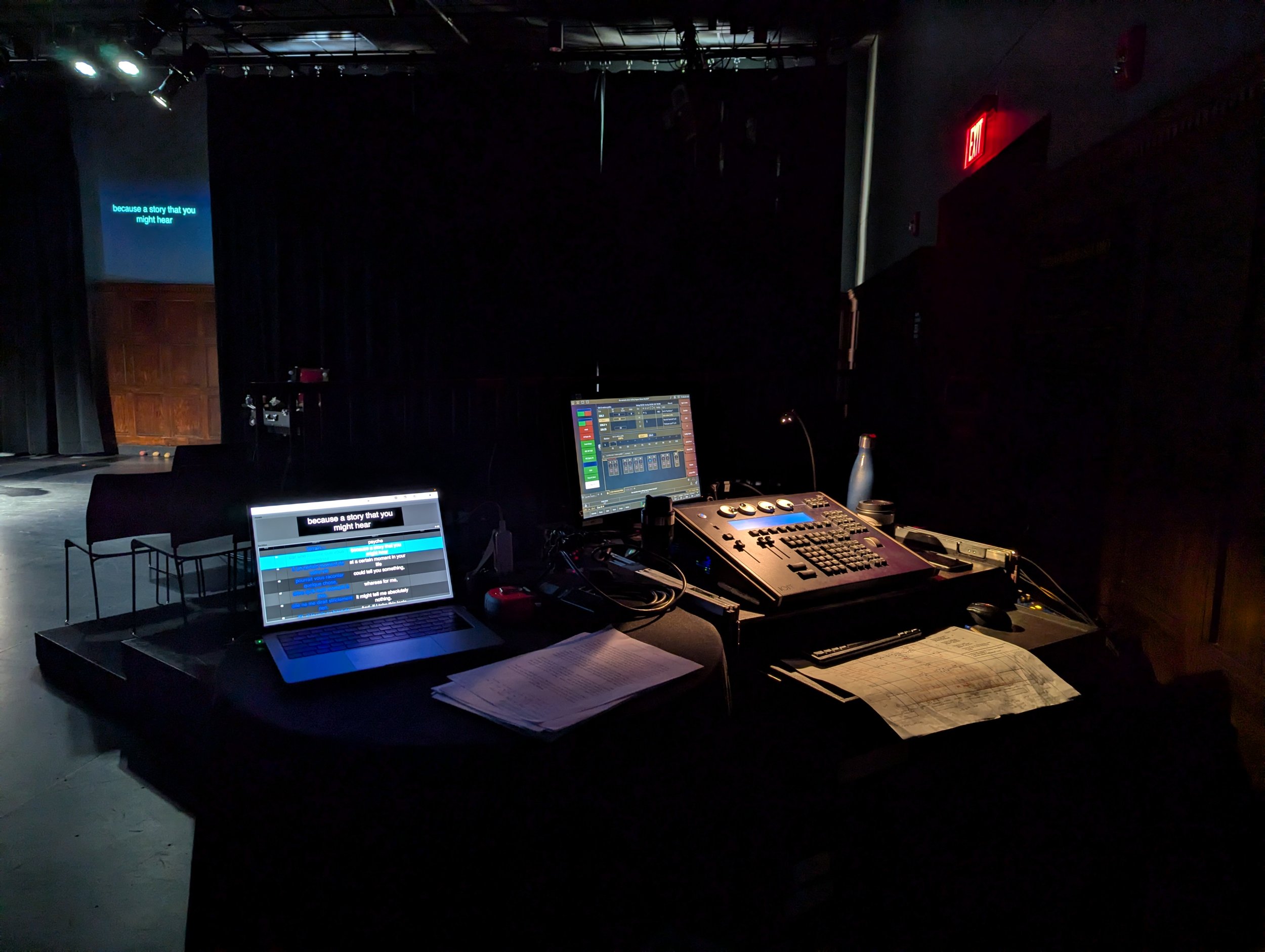
Surtitrage, or surtitling. Even as I type this, Google wants to correct surtitling to the more standard subtitling. That difference in naming, I recently learned, points to a difference in medium as well as positioning: while subtitles used in film flash across the bottom of the screen, surtitling used in live theater most often projects the actors’ dialogue sur, or above-stage. The measure of surtitles’ success? That audience members forget they are reading at all.
As it turns out, surtitling offers more for our consideration than a mere technical operation. Constrained by space - just two lines at a time - and the pace at which an audience member can reasonably read, surtitles sometimes eliminate up to 30% of the original script while remaining true to the semantic and dramatic undertones of the lines being delivered on stage.
To learn more about the choices that lead to a quality surtitrage, I recently sat down with Hanna Lasserre, Project Director at Panthea Software, one of Europe’s leading pioneers in surtitling software for live spectacle, and the provider of English surtitles here at French Theater Project. In what follows, Hanna illuminates why surtitling remains, for now, work that only humans can do, how surtitling democratizes access to the arts, and why a good surtitrage, c’est celui qu’on oublie.
The following interview has been translated from the original French and edited for length and clarity:
Hanna, you possess a doctorate in theater studies and have taught dramaturgy as well as staged your own mises en scène. Since 2014, you’ve held the role of Project Director at Panthea. Why surtitrage?
I should state that it was all rather spontaneous, really. I started doing theater when I was 14 years old. I remember envying the role of my drama teacher. I knew I always wanted to direct. After high school, I studied directing at a school in Belgium, and after university, I did direct for a while. But I returned to university because I wanted to focus my research on dramaturgy, specifically. I should say that for me, dramaturgy is at the heart of my work. And surtitling, it allows you to get close to a work in a very profound way.
Say more about that.
Because you are so close to the text, to the cadence of a work. And then there is the pleasure of understanding how language is operating within a piece (“le plaisir du mot”). As the surtitle operator, you acquire an intimate knowledge of a work of theater. You operate from the heart of a text.
We hear it all the time now: no sector is immune to the coming changes wrought by AI, including the arts. Surtitling likely strikes many audience members as a straightforward mechanical process. Is surtitling something AI can do?
I think that’s a huge misunderstanding that the audience might have, because after all surtitling isn’t just a mechanical process. Even with translation, I think people conceive of translation as something that AI can do on its own. But there are limits, for example how to faithfully render a work’s aesthetic and word choice. AI translates in a very literal way. And it lacks a certain sensibility. We are open to incorporating AI tools, but for the time being, we insist on maintaining humans at the core of what we do.
“Un bon surtitrage, c’est celui qu’on oublie”
What makes for a successful surtitrage?
For us, a successful surtitling is one audience members have no recollection of. If they’re not talking about the surtitling, that means we succeeded.
On the other hand, if there are spelling errors or phrasings that sound a little strange, or if there is too much written text for what is spoken on stage, audience members notice. The translation becomes a distraction, and audience members will leave having never been fully present to the action unfolding onstage.
OK, so let’s say the French Theater Project has just commissioned English surtitles for Alessandro Barrico’s Soie, adapted and performed by Sylvie Dorliat. Walk us through your process. What’s your first course of action?
The first step is inputting the original text into our software. We’re talking about an initial tidying-up (“on parle du nettoyage”). We reduce the initial quantity of text anywhere from 15% to 35%. To be clear, we’re not talking about a simplification of the text. We’re talking about essentialization (“essentialisation”). We retain only the information that is most vital to understanding what is happening on stage.
Then, we assign timestamps for each surtitle according to the rhythm of the action as it unfolds onstage. For example, if an actor speaks very quickly for a prolonged period of time, we work to further reduce the amount of written text to match that specific actor’s presence and timing onstage. If there is a change in cast member, we go back and adjust the surtitles to match that specific actor’s delivery . For plays that are frequently performed, like Hamlet, for example, the surtitles for each cast will look slightly different.
Only then do we hand over the reduced text to our translators.
“Une exigence pour que l'expérience spectatrice soit la plus complète et la plus agréable”
There is a growing recognition that translation is an art and that translators are co-creators of a work whose original intention they must retain and render legible to a different public. You mention that surtitling “essentializes” a work by removing up to 30% of the original text. Do you consider that by doing so, surtitling changes the original work?
I’d put it like this: we put ourselves at the service of an original work. We respect its chosen aesthetic. If there is a choice of archaic language, for example, we render that in the translation. Surtitling is not an artistic object in itself. It’s a function that works in service of an original work. It takes its cue from the delivery of the actors on stage.
Enfin, what current project are you working on with Panthea that you find particularly exciting?
We are dedicated to making bilingual theater widely available and we work to develop tools that democratize access to live theater.
At Panthea, we’ve developed smart glasses that allow individual spectators to select and view the language surtitles they require in real time. To better serve audience members who are blind or visually impaired, or who are deaf or hard of hearing, we’ve recently added sign language and audio descriptions. Always, we are guided by a philosophy whose objective is double: we seek to respect the essence and content of the original and to allow every audience member to experience a live performance in its totality.
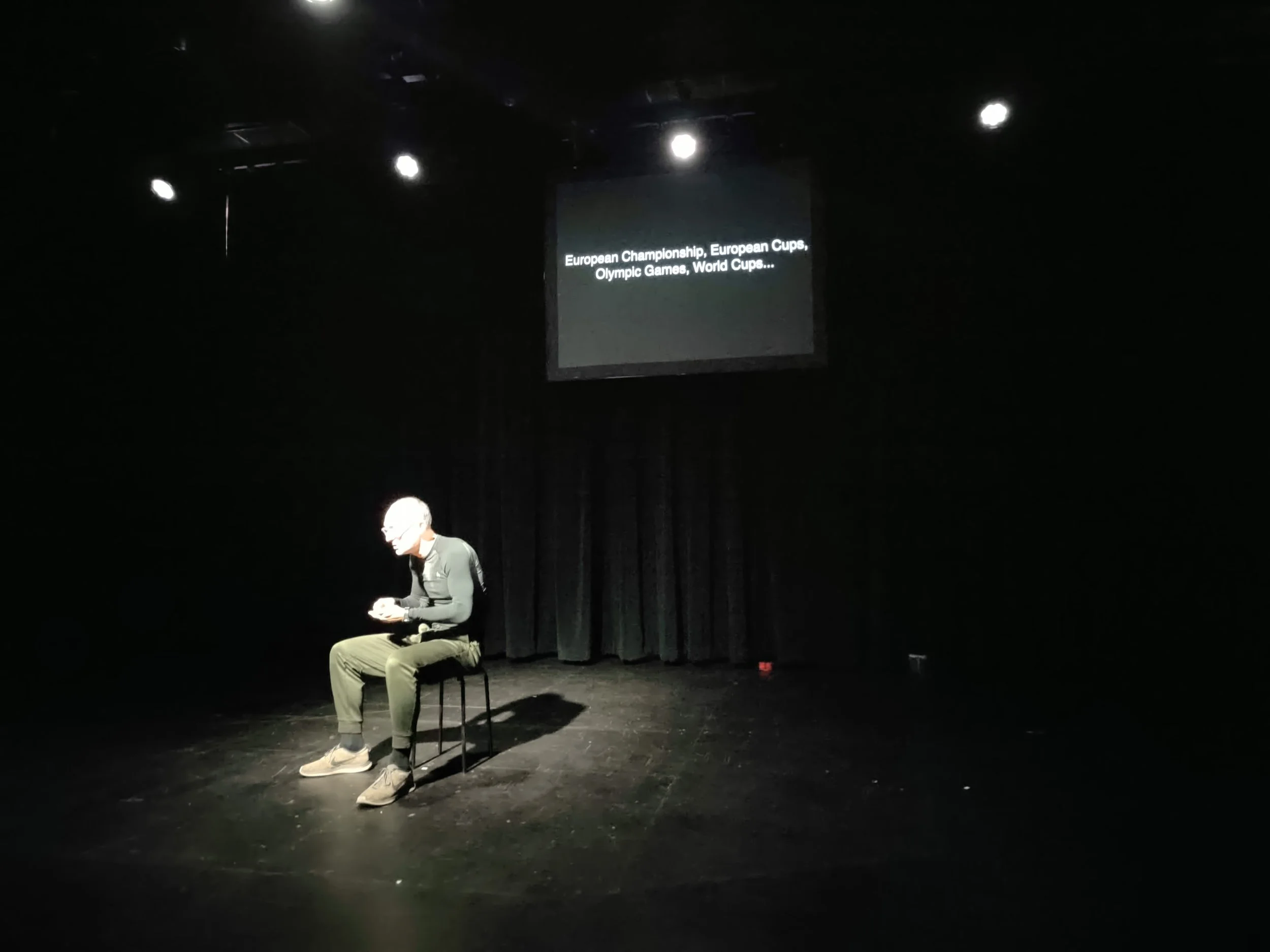
Tu seras un Homme Papa, 2024
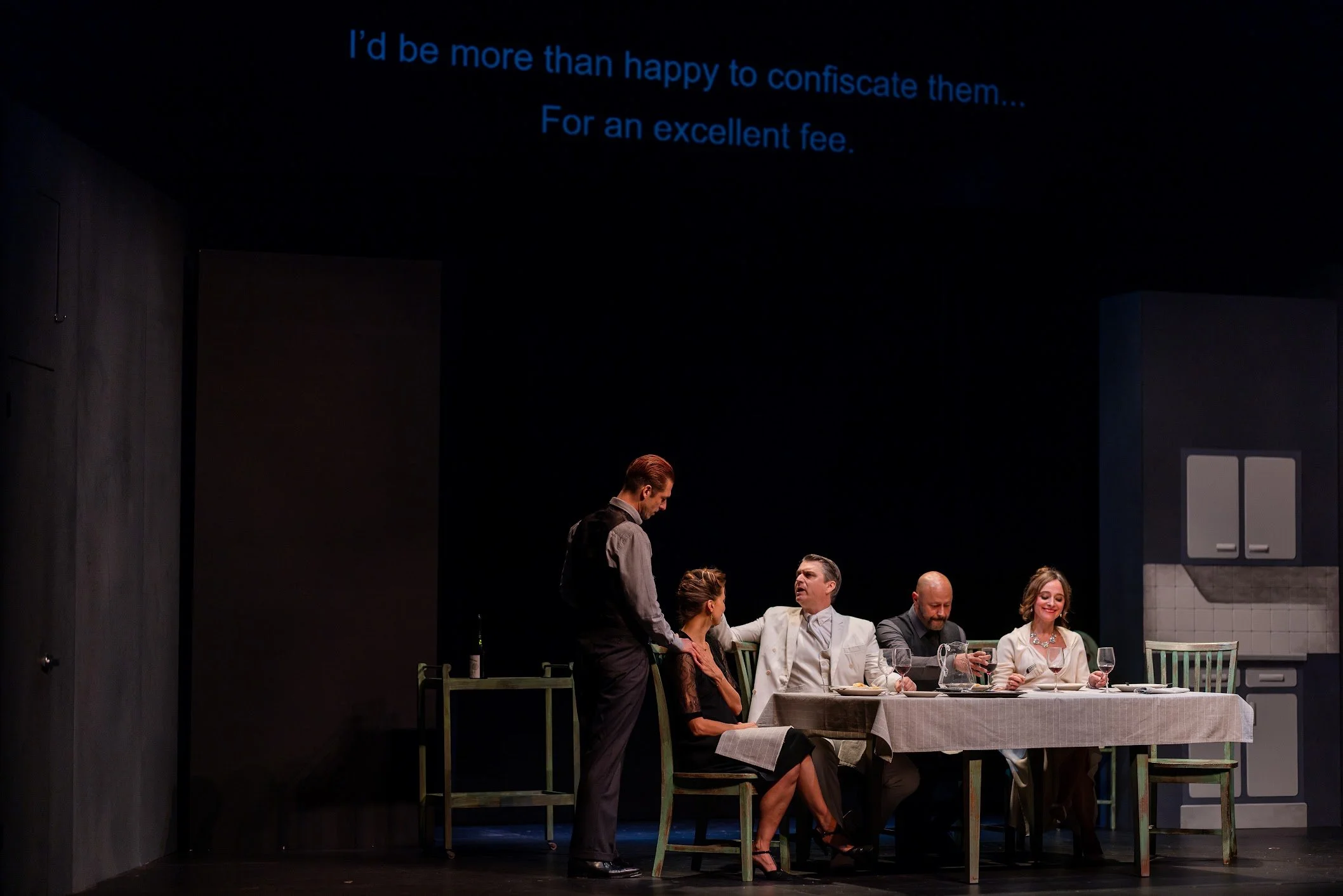
Adieu Monsieur Haffmann, 2025
